

£2.91 trillion.
A number that’s almost impossible to imagine
That is what the UK’s national debt has reached. It is such a large number that it almost loses all meaning, which is often the way with numbers that contain many zeros. Our brains can’t cope with the magnitude of them.
Put another way, £2,91 trillion is £2,910 billion. But even that can be incomprehensible.
So, let’s provide some context.
- If you spent £1 every second, day and night, it would take more than 92,000 years to spend £2.91 trillion.
- For each person living in the UK, that works out at around £43,000 of government debt. Of course, no individual receives a bill for this amount, but every taxpayer helps to pay the interest on that borrowing.
- £2.91 trillion is 145.5 billion £20 notes. Stacked together they would reach over 15,000 kilometres, enough to stretch from London to Australia.
- Wembley cost around £800 million to build. £2.91 trillion could build around 3,600 Wembley Stadiums.
Borrowing is not always a bad thing
The debt itself is not the biggest concern. The real issue is what it costs to service that debt each year, and how rising interest rates can make the problem much worse. Governments borrow for many reasons: to invest in infrastructure and essential services, like the NHS, respond to economic crises, fund the armed forces and, more recently, deal with the financial impact of the Covid pandemic.
Few people would argue that governments should never borrow. The question is whether the level of borrowing remains affordable over the long term. Just as a homeowner can comfortably manage a mortgage when interest rates are low, government borrowing is easier to manage when the cost of borrowing remains modest.
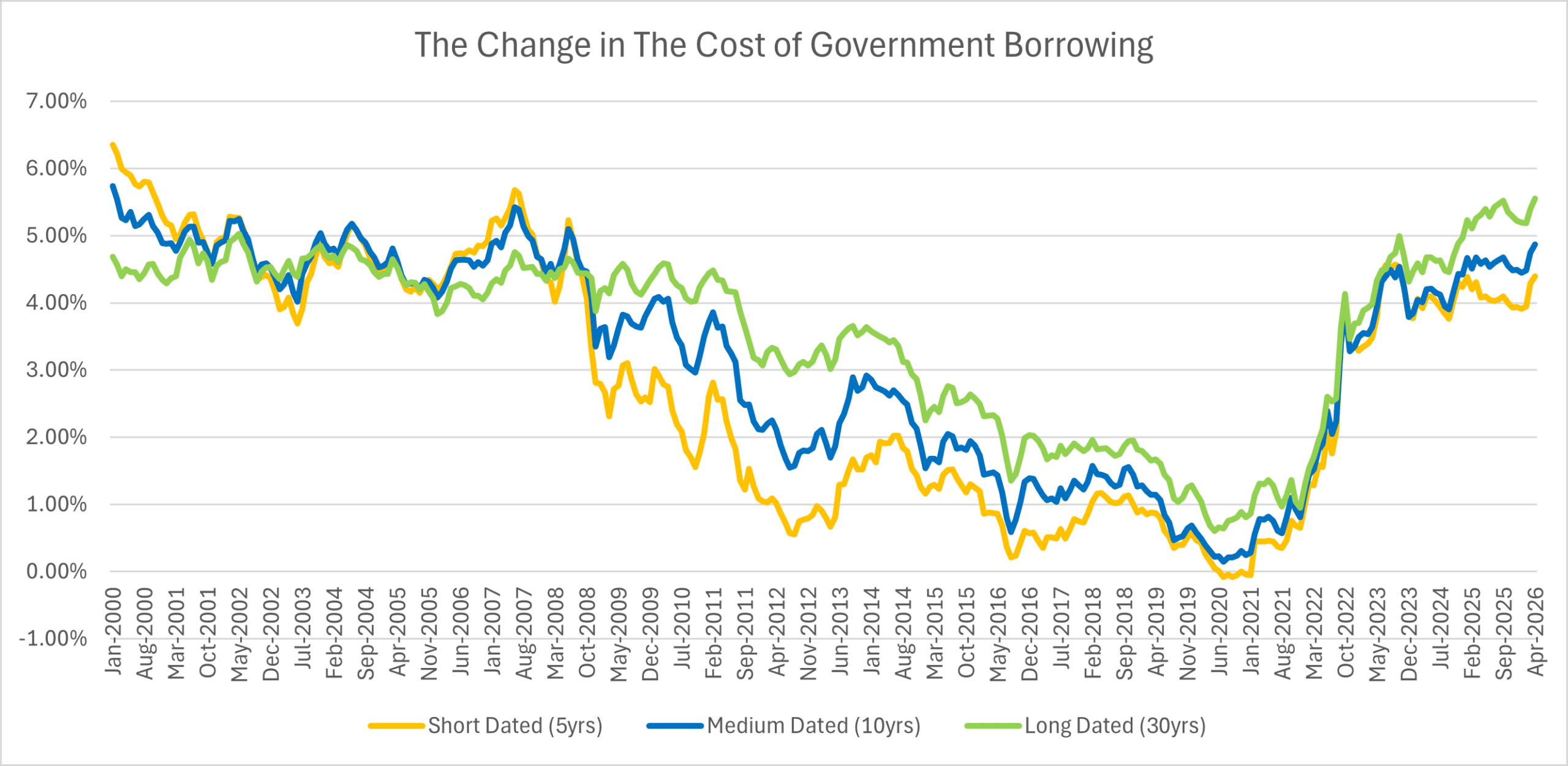
The chart below (data from https://www.instituteforgovernment.org.uk/explainer/gilt-or-bond-market) shows how the cost of borrowing for the government has changed since the start of the millennium. Post Credit-Crunch interventions kept yields very low, but since the pandemic they have risen sharply. Click to enlarge.
The hidden cost of debt
Many people focus on the size of the national debt, but the annual interest bill is what really affects the country’s finances.
In 2024/25, debt interest cost the Government well over £100 billion, making it one of the largest items of public spending.
Unlike spending on the NHS, education or defence, debt interest does not provide a public service today. It simply pays investors who have lent money to the Government in the past.
Problems begin when interest rates rise. Every single percentage point increase in the Government’s borrowing costs adds roughly £29 billion a year in interest. That is money that cannot be spent on healthcare, schools, defence or tax cuts.
Economists call this an opportunity cost. Every pound spent servicing debt is a pound that cannot be spent elsewhere.
- It cannot pay for more doctors or nurses.
- It cannot repair roads.
- It cannot invest.
- It cannot improve social care.
- It cannot be put into education.
Why higher interest rates matter
Imagine you have a repayment mortgage of £250,000. At an interest rate of 2%, the annual interest cost is around £5,000. If mortgage rates rise to 5%, the interest bill jumps to around £12,500.
The size of the mortgage has not changed. Only the interest rate has. Governments face exactly the same challenge.
The UK finances much of its borrowing by issuing government bonds, known as gilts. Global investors buy these bonds and receive interest in return.When interest rates rise, or investors demand higher returns, newly issued gilts become more expensive. As older borrowing matures and is refinanced, the Government gradually pays higher rates across more of its debt. Even a relatively small increase in borrowing costs can add tens of billions of pounds to the annual interest bill.
Why bond yields affect everyone
You may hear the news reporting that “gilt yields have risen” without explaining why it matters. A bond yield is simply the return investors expect for lending money to the Government. If investors believe inflation will remain high, or they become less confident about the UK’s public finances, they demand a higher return before lending.
Higher yields mean higher borrowing costs for the Government. This has exactly the same effect as a bank increasing the interest rate on your mortgage. The debt remains, but it becomes more expensive to manage.
When debt interest consumes a growing share of government spending, politicians face increasingly difficult choices:
- They can raise taxes.
- They can reduce spending on public services.
- They can borrow even more.
- Or they can hope that stronger economic growth increases tax revenues over time.
None of these options is easy.
Debt should be judged alongside the economy
The absolute size of the debt tells only part of the story. What matters more is whether the economy is growing fast enough to support it. A homeowner earning £200,000 a year can comfortably manage a much larger mortgage than someone earning £30,000.
The same principle applies to governments. If the economy grows strongly, tax revenues usually increase and debt becomes easier to manage. If growth is weak while borrowing costs rise, servicing the debt becomes progressively harder. This is one reason economists often focus on debt as a percentage of national income rather than simply quoting the headline figure.
What does this mean for your retirement?
For people approaching retirement, these choices matter because they influence future tax rates, pension policy, NHS funding, social care and public investment.
High debt does not automatically mean any of these things will happen, but it leaves governments with fewer options than they would otherwise have. If it can’t grow the economy sufficiently, the government are likely to face continued pressure to balance spending with taxation. That may affect future pension rules, tax allowances and the pace at which public services can expand. The alternative is to borrow to invest, which means adding to the debt pile.
The winners of rising borrowing costs are those choosing to purchase an annuity with their pension. Annuity rates are backed by the interest received from government bonds; higher interest equals higher annuity rates.
Andy Burnham’s Challenge
Borrowing has helped Britain navigate wars, recessions and a global pandemic. It has played an important role in supporting the economy during difficult times. As Andy Burnham takes office with a pledge to reduce the cost of living and get the economy growing again, his ability to do so will be heavily influenced by how his plans are perceived by the bond markets. And, as Liz Truss and Kwasi Kwarteng know, they aren’t to be taken lightly.