

Global stock markets are approaching all-time highs again, and for many investors, especially those in or approaching retirement, it can feel unsettling.
Previous market falls caused by COVID, the Cost of Living Crisis, Trump’s Tariff announcement and the immediate response to the Iran conflict still linger in the short-term memory.
When indices hit record levels, it’s natural to wonder if a correction is imminent.
But market highs are not warning signs. In fact, they’re a perfectly normal part of a long-term investment journey. It’s the unexpected events that trigger falls, not the market’s current valuation.
Highs Are Expected, Not Exceptional
The chart below shows the long-term performance of major global indices: the S&P 500 (US), FTSE 100 (UK), DAX (Germany), Nikkei 225 (Japan), and CAC40 (France). Source: Backtest by Curvo.
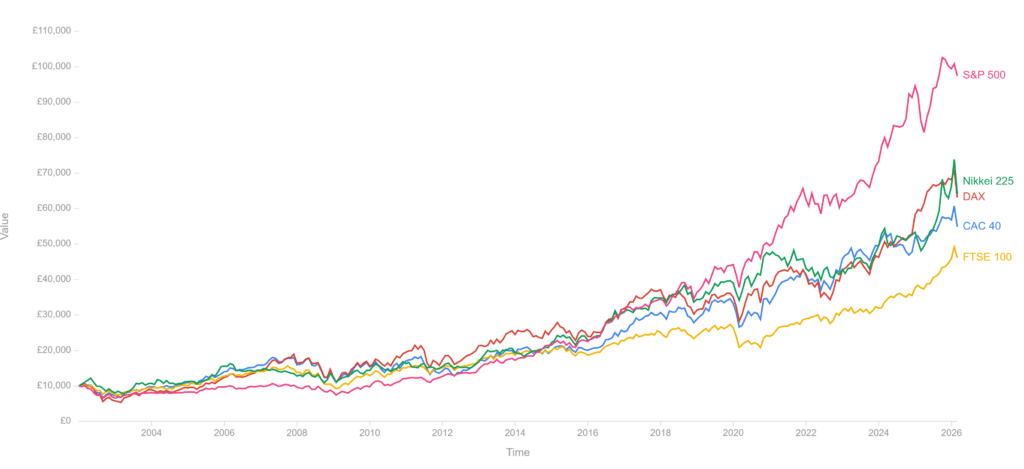
Despite different geographies, politics, and economic challenges, all of these markets have moved upwards over time.
All-Time Highs Happen All the Time
According to research by US based fund managers, Dimensional, considering whether an index has risen or fallen after reaching a market high, the S&P 500 was higher a year after notching a record high 81% of the time, and 86% of the time after five years. The chance of missing out by selling on a feeling that markets are too high is greater than the chance of losing out by staying invested.
Think of market highs like waypoints on a long walk. They are signs you’re heading in the right direction, not cliff edges that mark the end of the path. If the market never reached new highs, it would mean that long-term growth had stalled. There would be no point in investing.
If there were no point in investing, companies wouldn’t get the capital injection they need to meet the needs of their customers, innovation would cease, and economies would ultimately decline.
Staying The Course
For retirees or those planning for retirement, the priority should be staying invested in a suitably diversified portfolio that reflects your personal goals and time horizon.
Rather than fearing the cliff edge, see it as a feature of the landscape. They should be celebrated as another landmark visited, ticked off and keep going.
The Time To De-Risk
Everybody’s situation is different and investment strategies should match unique requirements and plans. There will be times when taking money out of the stock markets may be appropriate: for example, if the intention is to take a pension lump sum in full, or to purchase an annuity in the next two or three years.
In those situations, a significant capital loss in the short-term may be detrimental to your long term financial security and options. However, such decisions are influenced by personal circumstance, not the fear of market declines alone.